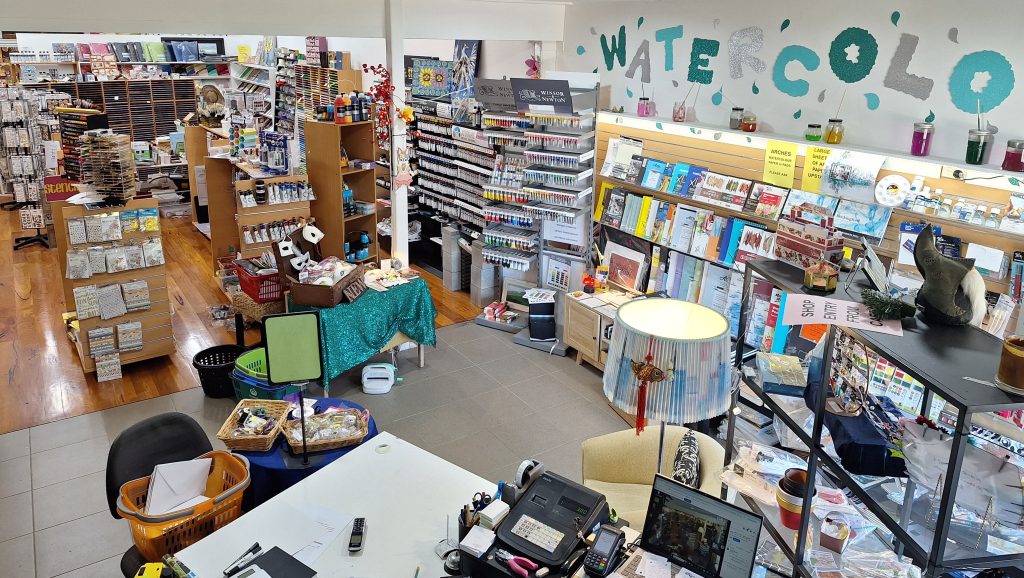
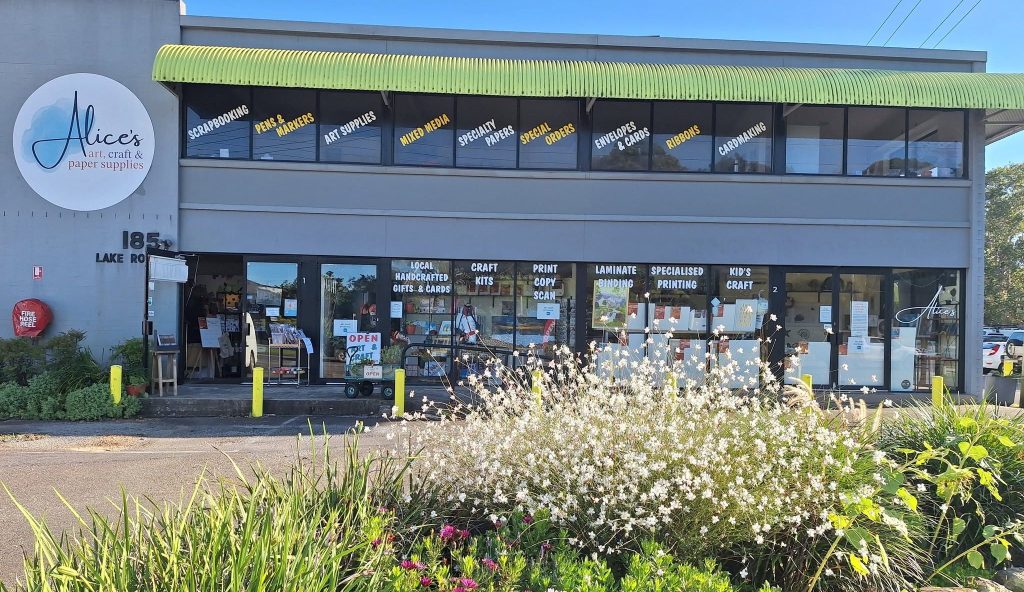
Inside the classroom at Alice’s Art, Craft & Paper supplies, a group of artists are working on their pastels, watercolours and drawing. It’s a weekly meeting made special by the coffee and cakes that Alice serves from her café. The sound of soft voices comes from the back of the shop where two women are debating which paper to use for a birthday invitation. The smell of coffee wafts over from the machine whirring away in the next room and Alice pops her head up from behind a display of paints with a warm welcome.
Alice’s, as the locals call it, is a special place in Port Macquarie where everyone is welcome, regardless of their creative ability. An art and craft supply store with a cafe attached and a packed roster of classes that is sure to inspire anyone’s creativity. ‘I just create things to bring the community together… I think that is the heart of my business… bringing people together’, Alice says.
Alice left her native Istanbul with her family at the age of eight for what she thought was to be a holiday, a cruise across the world to Australia and back again. It wasn’t until later, when she overheard her parents talking about school that she realised she wouldn’t be returning to Türkiye, and that she’d left all her favourite toys behind.
The family landed in Cremorne, an affluent suburb of Sydney and Alice started school without speaking a word of English. ‘I ended up in a school that didn’t really know migrants, so I really stood out as being a foreigner’, she remembers. ‘I was there for about six months and learned a little bit of English, but I wasn’t happy.’ It wasn’t until her family moved to Abbotsford among the loud, chaotic chatter of first-generation Italian families that the loneliness lifted. Surrounded by other children navigating two languages at once, she found her tribe.
Unwritten rules
Alice’s first foray into entrepreneurship was in her mid-twenties. Not long after having graduated from a bachelor of music teaching and the birth of her first child, she started Tot Music, a music appreciation school for children under the age of five. The theory at the time was that children under the age of eight couldn’t be taught to read and play music and Alice disagreed, so she promptly went on to disprove the theory. Watching four-year-olds compose tunes and play them on glockenspiels proved her theory right and the creative challenge of inventing new teaching methods kept her energised.
A few years later, Alice made the tough decision to wrap up the venture. ‘It had the potential to be very successful,’ she recalls, ‘but then the second child, and third child… it started becoming difficult because my kids were my priority.’ Welcoming groups of children and parents into her home every day had become a chore, she constantly had to ensure the place was tidy and her own kids’ toys were put away. Compounding the strain was a frustrating dynamic with a business partner who wanted to ‘come in, collect money, chit-chat, and split the earnings evenly,’ while Alice stayed up until 11:00 every night creating lesson plans. Ultimately, she chose to close the school and focus on enjoying her young family.
A tear comes to her eye when she thinks back to a moment that reminded her why she did the work. ‘Many years later I was at the train station and somebody approached me, this young person with a cello on her back. She said, “you don’t remember me, but my name is Wendy. You taught me my first notes.” She said, “I’m just going to the Conservatorium to do my final exam, because I’m going to be a music teacher.”’
Discarded scraps
Once her children were all at school, Alice turned to part-time music teaching in a local primary school and to helping her husband run his business. ‘I learned a lot of skills, things to do and things not to do’, she says. ‘He let me run certain parts of it [that] he didn’t want to deal with, and that would usually involve customer service because it was something I was good at.’
Part innate skill, part experience and training, Alice got her start in customer service at the age of fourteen while selling ice cream at Bondi Beach to make a little money during the summer. Later she worked at the cafeteria in The Commonwealth Bank, she explains, ‘I learned a lot about customer service through them and I was trained. They very quickly put me on serving the CEO of the bank… because I just had a way with dealing with people.’ She believes that it all comes down to communication, whether it’s negative or positive: just communicate.
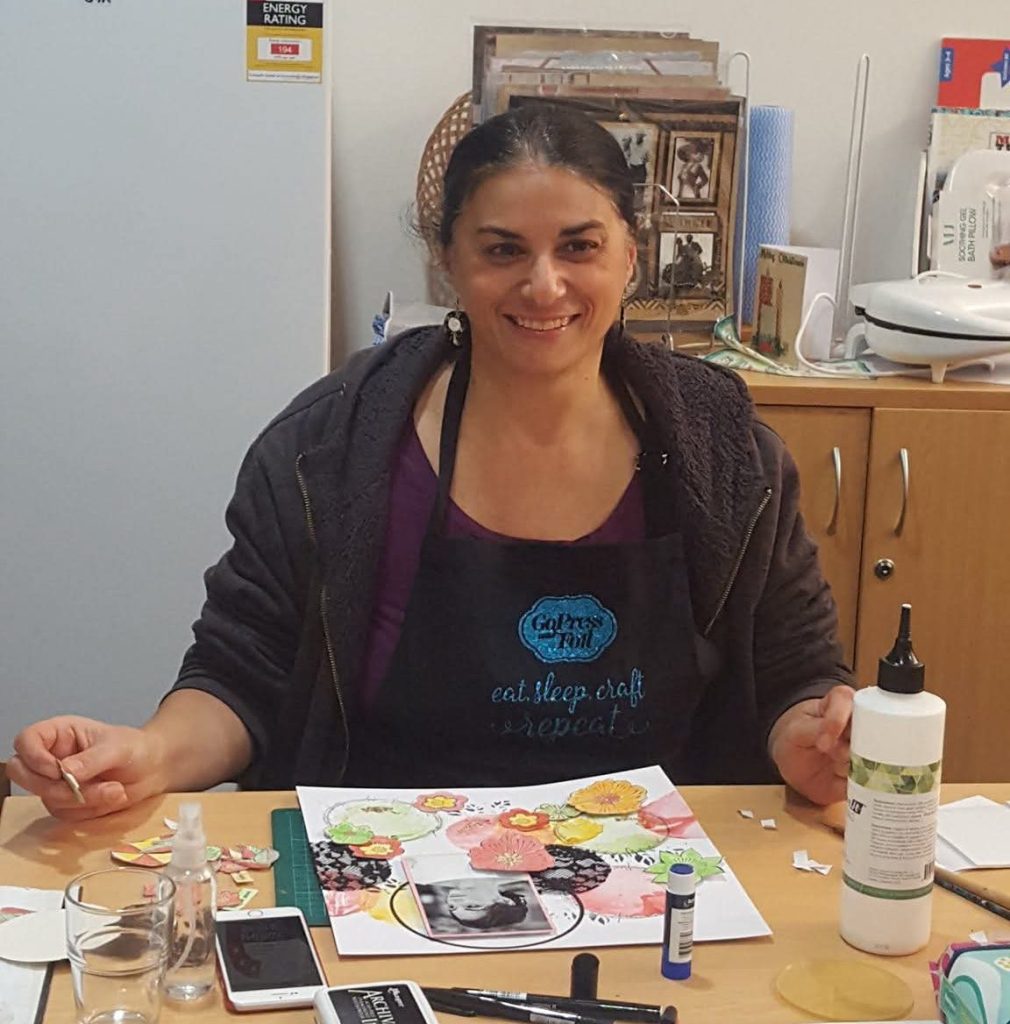
In her late thirties, a childhood friend invited Alice along to a craft show. Her reaction was lukewarm: ‘look, I’m not really into craft, but I’ll come and spend the day with you.’ As they wandered past row after row of colourful displays, her friend kept turning to her, insisting, ‘You’d be so good at this. You’d be so good at this.’ The words planted a quiet seed and by the time she walked back into the office, the idea was formed. Her husband ran a printing business at the time, surrounded by mountains of paper offcuts destined for the recycling bin. Alice marched into the warehouse, looked at the scrap piles, and announced to the everyone: ‘don’t throw any more paper out. I’m starting a business.’
‘Within six weeks I had the company name, I had the use of just a corner of the warehouse, and I packaged all these cards and I was selling offcuts,’ Alice explains. She also wrote a mission statement: ten points listing everything she wanted for her business, centred on customer service. It’s a list that she goes back to every year, a way to hold herself accountable to her original vision.
More than paper
Trying to get customers into the shop wasn’t easy and eventually she put a simple ad in a children’s magazine and people started coming from all over Sydney because no other shop was selling that kind of paper. From then on, Alice let her customers guide things. They’d ask if she had ribbons or rice paper and she would respond ‘I don’t have any, but I can get it in,’ and within the year she had quite a range of other products to go alongside the paper.
‘At first, it was a bit of a play thing,’ Alice says, but after about a year it started feeling very serious and she needed to make a decision: ‘I could either fold up or I could keep going.’ It was one day around this time that a call came in, like any other. It was someone who had been to the store, bought a few things but now she needed something else entirely. “I moved to a country area with my husband, and he suddenly died,” she told Alice. “I don’t know anyone here, and I’m desperate. Do you know anyone from this area?”
Alice hadn’t been around long enough to know people in the business, but she asked for the woman’s details anyway, and something about the postcode rang a bell. She flipped through her order book and found it, another customer, same small town. “Give me five minutes,” Alice told her.
She rang the second woman and laid out what had happened. “Leave it with me,” came the reply. “Give me her number. I’ll sort it out.” About a week later, the first woman called back. “I don’t know how to thank you,” she said. “I had nobody, and now I’ve got a family, they all took me in, they welcomed me into their craft groups.” She never went back to Sydney. ‘That’s when I realised this business was more than just selling paper,’ Alice says. ‘There was something special behind it.’
On the road
Little by little, the business that was initially called Alice in Paperland grew. It was daunting, but she stepped out from the safe corner of her husband’s printing warehouse. Leaving meant relinquishing free rent and familiar routines to take a risk in her own commercial space. But independence proved necessary, having her own storefront gave her room to breathe, experiment and do things her own way.
‘There were many times where I have thought, “do I really want to go on?” But, each time, something magical happened to pull me back and say, “no, your job’s not done.”’ Alice describes the feeling of a seven-year itch, that she desperately needs to make a significant change to her business so she can stay interested.
Around the time of that itch, customers had been repeatedly asking if she could take the shop on the road, so she packed up a van and took her paper collection on the road, popping up her shop in regional towns across the state.She travelled as far as five hours north to the town of Port Macquarie and realised that there was a huge region without any craft suppliers. Alice returned a couple of times to do more pop-ups and eventually decided to open a shop there for a one-year trial, just to see how it went. It was successful so she just kept it going.
At some point along the way something had begun to change in Sydney. ‘People weren’t driving, people didn’t want to come to classes,’ Alice remembers, ‘I don’t know if it was the area, but a lot had changed in the years that it was open.’ She spent a few exhausting years driving along the freeway up and down the coast to run both stores. She was having difficulty finding the right employees for the Port Macquarie store and the stress wasn’t easing, so she made the decision to sell the Sydney store and move north permanently to take care of her business, satisfying her fourteen-year itch. By then, her marriage had ended and her children were grown and scattered around the world, making the move a new, independent chapter.
Back to the mission
Alice’s business has been hit hard by competition from small businesses that run from their garages with little overhead and cheap sites like Temu, but she stopped listening to what was happening around her and doubled down on what made her business special, a physical space to bring people together.
Covid was bittersweet as she had to swap to contactless deliveries instead of welcoming customers into the store, but it also enabled her to achieve a long-held dream. She says ‘I have always, always wanted to have a shop with a cafe attached,’ and the combination of an adjoining shop becoming vacant and generous grants from the government at the time allowed her to open Coffee at Alice’s.
After about four years running both businesses, when she pulled out her ten-point mission statement for the annual check in, she realised she could only tick two items off, ‘all the customer service, everything that I wanted to do within my business, everything sort of went out the window.’ With a little sadness in her voice, she says ‘it was magical, it was fabulous, it was life-changing. I lived that dream, but then I had to let a part of it go, or change it to suit and go back to my mission.’
Alice had originally envisioned the café as a simple extension of the main store: just coffee, cake, and warm conversation. But small operational shifts quickly snowballed. ‘I needed staff, and then wages kept going up, so I had to expand the menu to cover the costs,’ she explains. ‘We added bacon and eggs, then the big breakfast. It grew to the point where I was in the kitchen most of the time trying to keep things running, instead of focusing on the heart of the business: the art and craft.’ Communicating her vision to new hires proved an uphill battle. Only one employee truly shared her dream ‘and she was trying to support me through the whole thing, but also pull me back because she could see how much stress I was under.’
The people around her commented on the bags under her eyes, the obvious exhaustion in her body and the flu-like symptoms that seemed to last months, but it took an old customer from the Sydney shop visiting for Alice to realise that something had to give. The customer had driven a long way hoping to sit and enjoy a catch-up with Alice after many years and, she says, ‘I couldn’t even utter one sentence to this woman who made the effort to come into the shop, and I thought, “this is not what I wanted.”’ It’s since gone back to what it was supposed to be, just coffee and cake for the customers in the store, but the decision wasn’t well received. ‘A lot of customers still kept coming back and asking when we were reopening because the food was good, wholesome and homemade.’
The support system
Reflecting on how she survived these changes, Alice recognises she didn’t do it alone. ‘Just when I need someone to walk in that door and change my business, someone walks in the door and changes my business.’ It started early, with a young minister who worked at the shop while putting himself through seminary. He wasn’t there long, but he was the first to show her the business wasn’t just about paper, it was something she was building for herself.
Then came Robin, a good thirty years older than Alice and meant to be well into retirement, who brought an energy and an instinct for the industry that Alice hadn’t had time to develop herself. It was Robin who pushed her to bring in an American card range with three hundred colours, fifty colours at a time, whatever the shop could afford. Robin insisted on paper from a new company nobody else was carrying yet, so that Alice’s shelves stayed ahead of the trends. When a new die-cutting machine came out of America, Robin was adamant: this was the future, and Alice needed to get them in. Alice was about to go in for minor surgery and would be out for the weekend, so she took a leap and ordered ten machines plus a load of dies, and left Robin in charge of the shop. By the time she was back on her feet Tuesday, Robin had run demos all weekend and sold every last one.
Through every version of the business, one person has stayed constant. Jackie has kept Alice’s books for twenty years, but she’s a friend, a confidant, and she’s the one who talks Alice down every time she gets an itch and wants to pack it all in. ‘She’s fiercely, fiercely supportive of my work,’ Alice says. Two decades in, Jackie still calls her boss.
The most recent arrival came right when Alice needed him most, in the exhausted, closing-down days of the café and the midst of her twenty-one-year itch. Gerard had worked in the arts industry in Sydney before moving up the coast, and their first exchange lasted twenty seconds, just long enough for him to offer his number before Alice was pulled away by a queue of customers. Weeks later, with the café shutting for good, she messaged and asked him to come in. Three and a half hours later, she had a new plan for the business, a rebrand built around what the shop had actually become: a fine art store that still carried papercraft, not the other way around. Within a month, she’d changed the entire layout of the store, hung the new signage, and launched Alice’s Art, Craft & Paper Supplies.
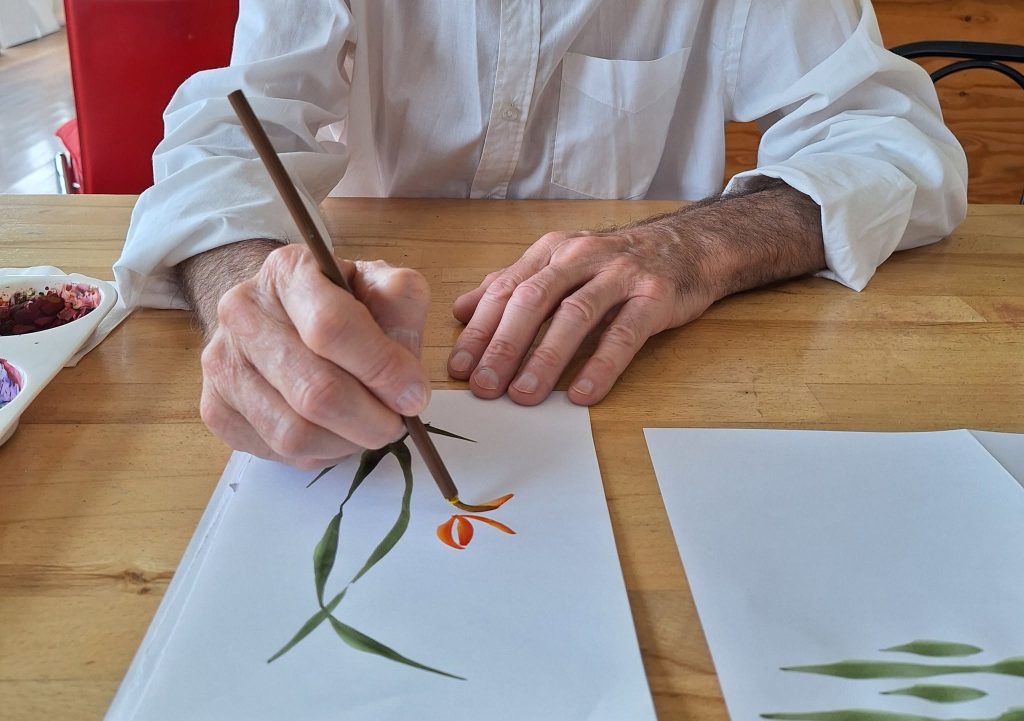
The whole business has changed since the rebrand and Alice is thoroughly enjoying supporting the local artists. ‘I get a lot of retired men… like doctors or big business owners, who retired and are lost. They want something, so I spend time with them on whatever they want to do like abstract painting, watercolour and help them through that. You see them coming back and you see the change in them. We’ve now got an abstract painting group, and there’s more and more men joining. I’ve been working and dealing with amazing people who’ve done incredible things, and now they’re at a point in their life where they’re looking for something, and I’m there to help them. It’s an amazing feeling.’
The rebrand marked a fresh chapter and Alice is thoroughly enjoying supporting local artists. Unexpectedly, her shop has become a haven for retirees searching for direction. ‘I get a lot of retired men like former doctors or big business owners who retire and feel lost,’ Alice says. ‘They want something creative, so I sit with them and work through whatever they want to try, whether it’s abstract painting or watercolour. You see them coming back, and you watch the transformation.’ It’s blossomed into a thriving abstract painting group with a growing roster of men. ‘I’m dealing with amazing people who’ve done incredible things, and now they’re at a point where they’re looking for their next spark. Being there to guide them is an amazing feeling.’
The next chapter
As she thinks about what’s important, she says, ‘I used to think that success was having lots of money in the bank, having a name that everybody knows… but I think it all comes back to the community. That’s what I wanted for my business and that’s exactly what I have.’ She jumps out of bed in the morning excited to work, knowing that the day will be different to the one before and creative in some way.
Alice is looking towards the future now, wondering if the twenty-eight-year itch will be the final chapter of this business. She knows she will never fully retire, only shift her focus: ‘There’s another side of me that’s an artist, and I want to do more with that. I want people to recognise my work, so I want to sell it and have people buy it knowing that it’s my work.’
Now in her early 60s, the girl who once landed in Australia unable to speak a word of English has spent a lifetime building her home. She is not alone; Alice has built a community around her.
Alice’s Art, Craft & Paper Supplies
1/185 Lake Road Port Macquarie
https://alicesartcraftpaper.com